
Recommended time to visit Africa for Safaris
Best Time for an African Safari Holiday
It is everyone’s dream to visit Africa For a safari holiday, but most don’t know when is the best time for an African Safari. To understand the best time for an African Safari, you will need to understand the seasons of the year that occur at different times of the year.
The best time to go on safari is during the dry seasons, which are January to March and June to October for the majority of sub-Saharan Africa. Water is scarce at this time so animals tend to congregate at water sources, making them easier to spot (for safari-goers and predators).
However, we also thoroughly recommend visiting parts of Africa just after the wet season, such as January to March. At this time, the savannah is green, the woodlands teem with birdlife, and there are fewer visitors to the parks, offering you a wilder, more remote safari.
Although the January to March Season is when the Calving Season happens, the great wildebeest migration action happens during the busiest months, which are from July to October, in Kenya and Tanzania. The wildebeest migration guide helps you understand how the wildebeest migration moves month by month from the Serengeti to the Masai Mara.
Best time to do an African safari
When planning your African safari, it’s important to consider the best time to visit each region. The dry season from June to October is generally considered the best time for game viewing as animals congregate around water sources. However, some regions have unique seasons that offer a different kind of experience.
Safaris are an activity that can be enjoyed throughout the whole year. The time of year you decide to go will depend on your interests and your budget, but in general, there is something to offer everyone at all times of the year. Practically all destinations are popular destinations for those seeking a unique safari adventure, as each location has something unique to offer.
Month By Month Travel Guide
Month Safari Guide for safaris in Africa
While everyone has their own memories of Africa they take away with them, the wildlife makes for some of the most magical to remember. Lucky for you, the vast continent of Africa boasts the widest diversity of wildlife in the world and is home to the most extraordinary wildlife sightings, spectacles, and gatherings than anywhere on the planet.
As most people travel to Africa to witness its glorious diversity of wildlife up-close and first-hand, winter in Africa, between June and October, is undoubtedly the best time to go on the ultimate wildlife safari in Africa.
January
The herds are in Tanzania’s Serengeti National Park, moving south from the northeast region of the park and into the area near Lake Ndutu Conservation Area and the southern region of Serengeti. The Serengeti is not fenced, so the herds are free to move where they can find green grass and water available for calving.
Remember that although up to two million wildebeest, zebra, and antelope form the Serengeti Migration, they are not all in a single herd. The animals break up into mega-herds of thousands or hundreds of individuals at a time.
February to March
It is the calving season (over 8,000 wildebeest calves are born each day!) so prepare yourself for lots of bubbly calves… and lots of heartbreak as the big predators hunt them down. The Serengeti’s big cats take the big share, but hit-and-run jackals, packs of wild dogs, and hyena clans add to the spectacle, making it a thrilling experience. It’s a bittersweet experience; the circle of life drama is played out as a documentary on NatGeo, live on the ground.
If the short rainy season (Nov–Dec) produces good grazing and plenty of vegetation, the herds feed with no hurry and remain in the Serengeti’s southern plains until they slowly start moving west in March.
April
It’s the start of the long rains in the Serengeti (Apr–May), and the herds generally move in a north-westerly direction towards the Moru and Simba Kopjes. The action-packed rutting (breeding) season is in full swing, featuring testosterone-fuelled jousts between males competing for the right to mate with receptive females.
May
The Wagons herd rolls towards the north! The massed herds are on the go, huge columns of up to 40 kilometers (25 miles) in length can sometimes be seen as the wildebeest funnel up into the central Serengeti. Everyone’s moving a little quicker now that the calves are stronger. Also, due to rain and water, the herds seem to move faster north as the rain falls around the northern region.
June
The wildebeest are usually in the central Serengeti and getting ready for the toughest part of their odyssey. The herds may have split up, with some already crossing the Grumeti River.
July
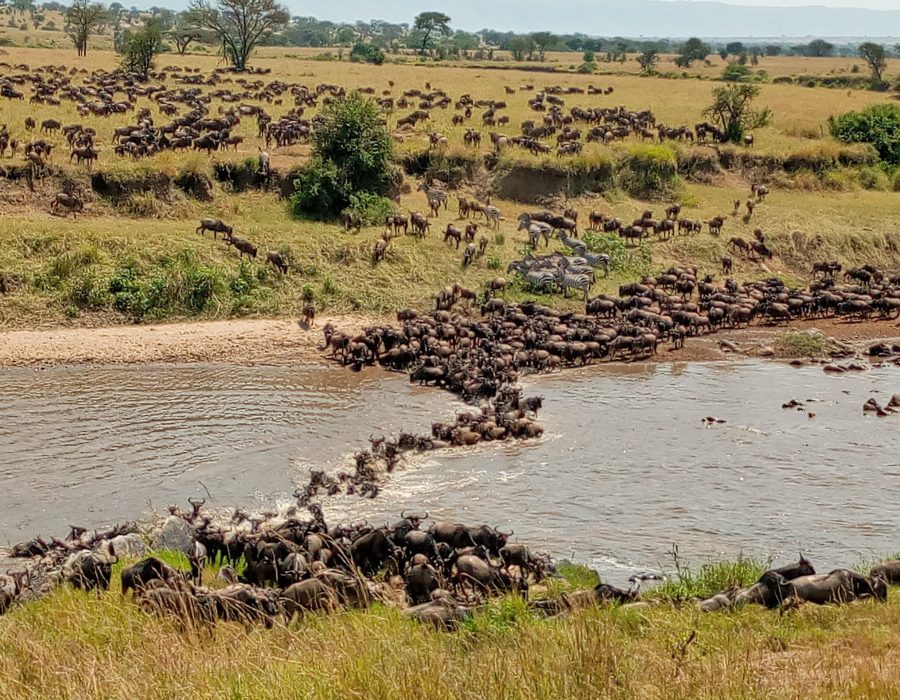
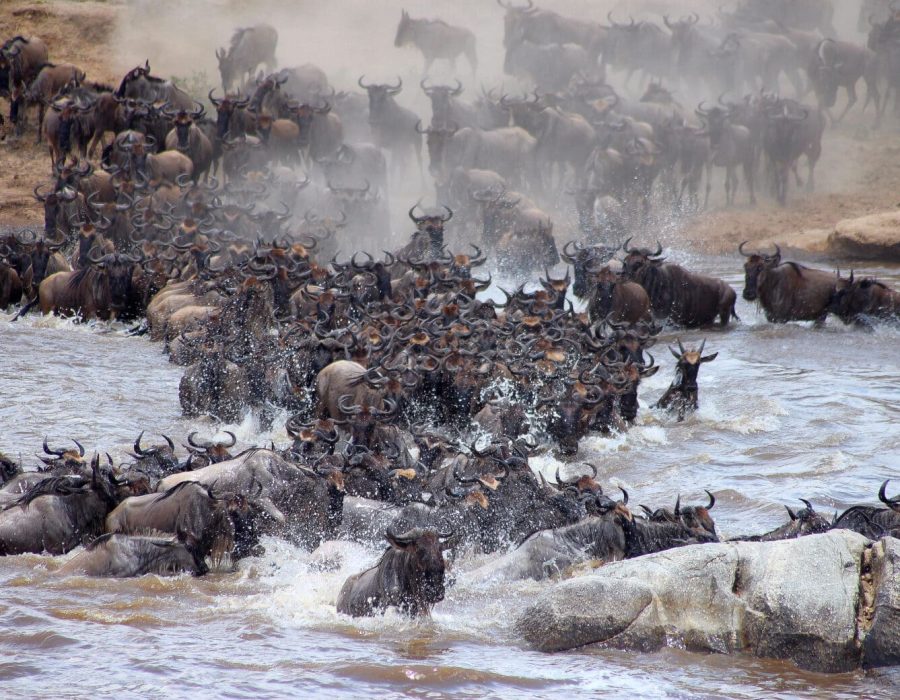
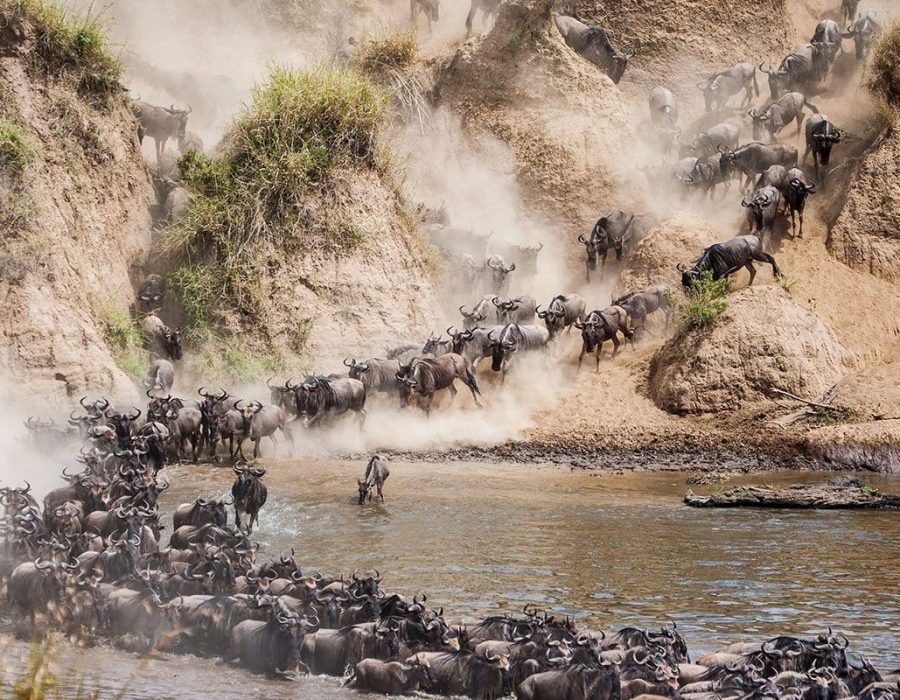
The Great Migration has reached the Grumeti region and northern parts of the Serengeti, and is peering closely at the infested waters of the Mara River, which they have to cross into Kenya. Why? Huge Nile crocodiles, waiting for them, that’s why!
As mentioned, it is impossible to accurately predict wildebeest river crossings in either Serengeti or Masai Mara; they depend entirely on the rains and the often unpredictable wildebeest themselves. But the main and vital thing that makes them migrate is their biological clock. From July to October, they come to the Masai Mara to mate due to the favorable climate conditions, and in Jan and March, they give birth.
It’s vital to book your Wildebeest Migration safari in Africa up to a year in advance to get a camp or lodge on or as close to the river as possible – this cuts down on travel time to lookout/crossing points.
The wildebeest do have historical crossing areas, and you may spend days staked out in the hope of seeing the crossings. We recommend choosing a mobile safari camp that moves with the Migration to ensure you’re in the right place at the right time to witness this major world wonder.
August
August is generally considered the best time to witness the dramatic wildebeest river crossings from the northern Serengeti into the Masai Mara through the Mara River. You’ll need a passport to cross into Kenya; the wildebeest are exempt. The Masai Mara National Reserve is open to members of the public, so for a more exclusive safari experience, book camps and or lodges inside the reserve or within the reserve.
September
The wildebeest herds break up into smaller groups, as not all the wildebeest migrate into Kenya. Less than half of the animals remain in the northern Serengeti; the rest are swapping war stories in the Masai Mara. So you could still see wildebeest in the Serengeti (just not the mega-herds), but as a general rule of thumb, the Masai Mara is the best place to witness the Migration in September.
October
Your best bet is still the Masai Mara, but bear in mind it is a far smaller reserve than the Serengeti, and there may be a lot of other visitors. The wildebeest herds graze widely in the reserve and fill the entire reserve and neighboring conservancies. Some groups move down to the Northern Serengeti from the Masai Mara.
November
In a ‘normal year,’ the short rains have begun, propelling the wildebeest to leave the now-denuded grasslands of the Masai Mara and head back into the rejuvenated Serengeti. Bear in mind that the rain can be late or early, which is also unpredictable.
The herds are generally on the move but can be seen around the north-eastern parts of the Serengeti, where they may split into smaller groups for their journey southward.
December
Fresh grazing sees the wildebeest move south, covering the northern and eastern Serengeti to feast and prepare for yet another death-defying, 1000-km odyssey.
The Great Migration Schedule - Month by Month
Where The Wildebeest Migration Start
We will guide you below to understand the best time for the wildebeest migration in Kenya and Tanzania. Using our Wildebeest Migration Map, below is a Month-to-month Wildebeest Guide that shows the wildebeest movement between seasons and months. We have another guide that shows a month-to-month guide for wildebeest migration, from January to December, explaining their activities and movements, and where to see them in different months.
Wildebeest Migration Map
Detailed Wildebeest Migration Map - Wildebeest Migration Routes
The Wildebeest Migration Map shows the yearly and monthly movement of the wildebeests. As they migrate from the South after birth to the North of the Serengeti and finally into the Masai Mara in Kenya.
The Monthly guide on the map shows various locations you would probably sight in the different months of the year.

Subscribe to Wildebeest Migration Updates
Get Real Time updates on our Socials
Stay up to date with our Wildebeest Migration Updates each year from January to December.
Previous Wildebeest Sightings
Explore the nearest safari camps and lodges where the wildebeest migrations were seen and spotted. We recommend these wildebeest migration camps and lodges.

Large herds of wildebeest have been spotted moving across the Southern Serengeti, with many calves seen traveling alongside them. The groups...

Another wildebeest birth has been observed on the Southern Serengeti plains, adding to the ongoing calving activity in the region. The...

Another wildebeest birth has been recorded in the Southern Serengeti during the ongoing calving season. The mother was observed delivering her...